
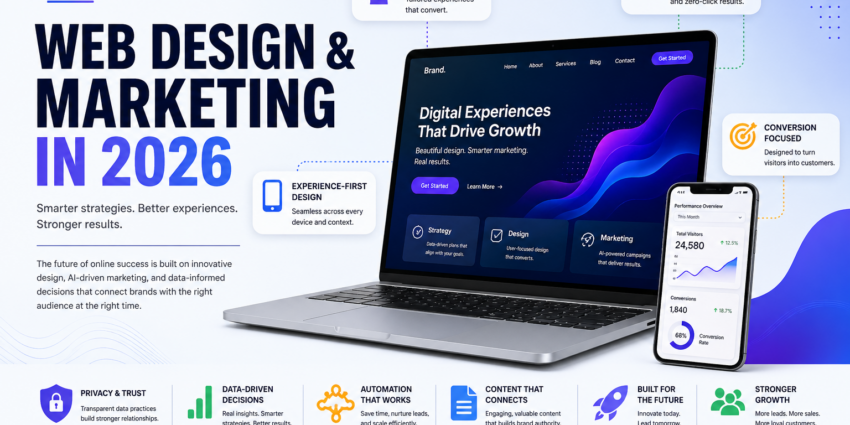
Web design and marketing in 2026 operate as a tightly integrated system rather than two separate disciplines. The modern website is no longer just a digital brochure; it’s a dynamic, data-driven growth engine that adapts in real time to user behavior, search algorithms, and AI-powered ecosystems. Businesses that treat their website as a living asset, continuously optimized and aligned with marketing strategy, are the ones capturing attention, leads, and long-term brand equity.
The Shift to AI-First Experiences
In 2026, artificial intelligence is embedded into nearly every layer of web design and marketing. From personalized content delivery to predictive user journeys, AI has redefined how websites interact with visitors. Instead of static pages, users encounter adaptive interfaces that change based on browsing history, intent signals, and demographic data.
For example, a returning visitor might see different messaging, offers, or layouts compared to a first-time user. AI tools analyze engagement patterns, scroll depth, click behavior, time on page, and dynamically adjust elements such as headlines, calls to action, and even imagery. This level of personalization significantly increases conversion rates because users feel the experience is tailored specifically to them.
On the marketing side, AI is driving smarter campaign management. Ad platforms, email automation, and content distribution systems now rely heavily on machine learning to optimize targeting, timing, and messaging. Marketers are no longer guessing; they’re interpreting data-driven recommendations and refining strategy accordingly.
Search Has Evolved Beyond Keywords
Search engine optimization (SEO) in 2026 looks very different from what it was just a few years ago. Traditional keyword stuffing and backlink quantity have given way to semantic search, intent matching, and AI-generated summaries.
Search engines now prioritize context, authority, and user satisfaction. Content must answer real questions in a comprehensive and structured way. Websites that demonstrate expertise, experience, authority, and trustworthiness (E-E-A-T) are consistently rewarded with higher visibility.
Another major shift is the rise of AI search interfaces. Instead of clicking through multiple links, users often receive synthesized answers directly in search results. This means your website content must be optimized not just to rank, but to be selected as a source for these AI-generated responses.
Structured data, clear formatting, and authoritative content play a crucial role here. FAQs, concise explanations, and well-organized sections increase the likelihood of being featured in these summaries.
Mobile-First Is Now Experience-First
While mobile-first design has been standard for years, 2026 has pushed this concept further into what can be described as “experience-first” design. It’s no longer just about screen size—it’s about context.
Users interact with websites across multiple devices: smartphones, tablets, desktops, smart TVs, and even wearable tech. A successful website delivers a seamless experience across all of them. This includes consistent branding, fast load times, intuitive navigation, and frictionless transitions between devices.
Speed remains a critical factor. Users expect near-instant load times, and even slight delays can lead to higher bounce rates. Core Web Vitals and performance metrics continue to influence rankings and user satisfaction. Lightweight design, optimized media, and efficient coding practices are essential.
Conversion-Centric Design
A visually appealing website is no longer enough. Every element must serve a purpose, and that purpose is typically tied to conversion, whether it’s generating leads, making sales, or encouraging engagement.
In 2026, conversion-focused design relies heavily on behavioral psychology. Elements such as social proof, urgency, and trust signals are strategically placed throughout the user journey. Testimonials, reviews, case studies, and real-time activity notifications help build credibility.
Calls to action (CTAs) are more refined and personalized. Instead of generic phrases like “Contact Us,” users might see CTAs tailored to their stage in the buying process, such as “Get Your Custom Quote” or “See How It Works for Your Business.”
Additionally, micro-interactions—small animations or responses triggered by user actions—enhance engagement and guide users toward desired outcomes. These subtle design features make the experience feel intuitive and responsive.
Content as the Core of Marketing
Content remains the backbone of digital marketing, but the way it’s created and distributed has evolved. In 2026, high-quality, multi-format content is essential for visibility and engagement.
Written content is now complemented by video, audio, interactive tools, and visual storytelling. Short-form videos, in particular, dominate social platforms and are increasingly embedded within websites to capture attention quickly.
AI-assisted content creation has streamlined production, but authenticity is more important than ever. Audiences can easily detect generic or low-value content. Brands that inject personality, expertise, and originality into their messaging stand out in a crowded digital landscape.
Content strategy is also more interconnected. Blog posts, social media, email campaigns, and website pages are all part of a cohesive ecosystem designed to guide users through the customer journey.
The Rise of Zero-Click Marketing
Zero-click marketing has become a defining trend. Users often find the information they need without ever visiting a website, thanks to featured snippets, AI-generated answers, and social media previews.
This doesn’t mean websites are less important; it means they must provide deeper value. While top-of-funnel information may be consumed elsewhere, your website needs to deliver comprehensive insights, tools, and experiences that can’t be replicated in a snippet.
Interactive calculators, detailed guides, downloadable resources, and personalized recommendations are examples of content that encourage users to engage more deeply once they arrive on your site.
Data Privacy and Trust
With increasing concerns about data privacy, transparency has become a key component of both web design and marketing. Users are more aware of how their data is collected and used, and they expect clear communication and control.
Websites in 2026 prioritize privacy-first design. This includes straightforward consent mechanisms, minimal data collection, and secure handling of user information. Trust badges, privacy policies, and transparent messaging help reassure users.
From a marketing perspective, first-party data is now more valuable than ever. Businesses focus on building direct relationships with their audience through email lists, memberships, and loyalty programs rather than relying solely on third-party data sources.
Integration of Automation and Human Strategy
Automation plays a significant role in 2026, but it doesn’t replace human strategy; it enhances it. Marketing automation tools handle repetitive tasks such as email sequences, lead nurturing, and campaign optimization, allowing marketers to focus on higher-level strategy and creativity.
Similarly, AI-powered web design tools can generate layouts, suggest improvements, and even build entire pages. However, the most effective websites are those that combine these tools with human insight, ensuring the final product aligns with brand identity and business goals.
Branding and Differentiation
As digital spaces become more saturated, strong branding is critical. In 2026, a website must communicate a clear and compelling brand identity within seconds.
This goes beyond logos and color schemes. It includes tone of voice, messaging, visual style, and overall user experience. Consistency across all touchpoints, website, social media, email, and advertising, reinforces brand recognition and trust.
Storytelling is a powerful tool for differentiation. Brands that effectively communicate their mission, values, and unique selling proposition create emotional connections with their audience, leading to higher engagement and loyalty.
The Future Outlook
Looking ahead, web design and marketing will continue to converge. Technologies such as augmented reality (AR), virtual reality (VR), and voice interfaces are expected to play a larger role in how users interact with digital content.
Voice search, in particular, is reshaping how content is structured. Conversational language, question-based content, and concise answers are becoming increasingly important.
Ultimately, success in 2026 comes down to adaptability. The digital landscape evolves rapidly, and businesses must be willing to test, analyze, and continuously refine their strategies.
Web design and marketing are no longer static disciplines; they are ongoing processes driven by data, technology, and user behavior. Those who embrace this mindset and invest in both areas holistically will be best positioned to thrive in an increasingly competitive online environment.
Appsolute Web Design & AI Marketing Services
 Offices: Where You Are – I have a laptop and will travel
 Phone: 631-466-0461
 Website: AppsoluteSuccessApps.com/
 Email: info@appsolutesuccessapps.com