
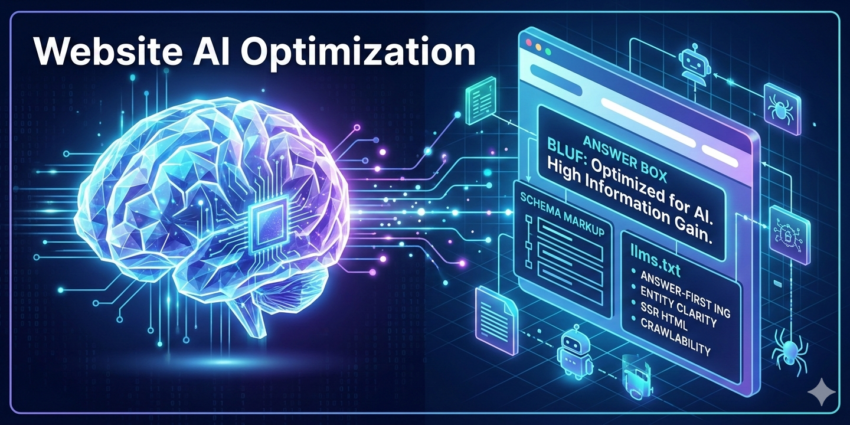
In 2026, the internet has reached a tipping point. We are no longer just building websites for humans to browse; we are building data sources for Artificial Intelligence to ingest. With the rise of Generative Engine Optimization (GEO) and Answer Engine Optimization (AEO), the goal of a website has shifted from “being found” to “being cited.”
If your content isn’t structured for Large Language Models (LLMs) like Gemini, ChatGPT, and Perplexity, you are effectively invisible to a third of the searching population. Here is the definitive guide to optimizing your website for the AI-first era.
1. The “Answer-First” Architecture
AI models are designed to find the “Bottom Line Up Front” (BLUF). They don’t want to dig through 500 words of “Why B2B marketing matters” to find your specific lead generation strategy.
To optimize for extraction:
- The Answer Capsule: Place a 40–60-word direct answer immediately following an H2 or H3 heading.
- Modular Sections: Treat every section of your blog as a self-contained unit. An AI should be able to “lift” that section and use it as a complete answer without needing the rest of the page for context.
- The Wikipedia Method: Start with a concise definition, then a bulleted list of key facts, and finally dive into the nuance.
2. Technical SEO: Feeding the Bots
In 2026, technical SEO is about Crawlability and Ingestibility. If an AI agent has to spend too much “compute” (processing power) to understand your site, it will move on to a simpler source.
The Rise of llms.txt
Just as robots.txt tells bots where they can go, a new standard, llms.txttells them what to learn. This is a Markdown-based file in your root directory that serves as an AI “cheat sheet”. It provides a clean, text-only version of your most important data, stripping away the “noise” of JavaScript and CSS.
Eliminate JavaScript Dependence
While Googlebot has become better at rendering JavaScript, many real-time AI agents (doing Retrieval-Augmented Generation, or RAG) avoid it to save time.
- Server-Side Rendering (SSR): Ensure your “meat”, the data, the claims, and the answers are present in the raw HTML.
- Speed is Non-Negotiable: Aim for a Time to First Byte (TTFB) under 200ms. If your site is slow, the AI’s “Time-to-Fact” is too high, and you’ll lose the citation.
3. Entity-Based Optimization
AI doesn’t just look for keywords; it looks for Entities (people, places, brands, and concepts) and the relationships between them.
| Traditional SEO | AI Optimization (GEO) |
| Focus: Keyword Density | Focus: Entity Clarity |
| Metric: Search Volume | Metric: Information Gain |
| Goal: Page 1 Ranking | Goal: AI Citation/Mention |
To win here, use Schema Markup (JSON-LD) aggressively. Don’t just tell the AI you have a “Product.” Use Schema to link that product to its “Manufacturer,” its “Material,” and its “Energy Rating.” This builds a “Knowledge Graph” that makes your site a definitive authority in the model’s eyes.
4. Prioritizing Information Gain
AI models already have “average” information in their training data. If your blog post simply summarizes what’s already on the web, an AI has no reason to cite you. You must provide Information Gain.
How to provide gain:
- Original Research: Publish proprietary data, surveys, or benchmarks.
- First-Person Experience: AI cannot replicate the “I tried this for 30 days” narrative. Use E-E-A-T (Experience, Expertise, Authoritativeness, Trust) signals like author bios and case studies.
- Specifics over Generics: Instead of “Social media is growing,” say “Our analysis of 1.2M LinkedIn posts in Q1 2026 shows a 14% shift toward video carousels.”
5. Managing Your Bot Permissions
You need to be strategic about who you let in. Your robots.txt should be updated for the 2026 protocol:
- Allow
OAI-SearchBot: This allows OpenAI to surface your site in real-time search results (where the clicks happen). - Strategize
Google-Extended: This determines if your content helps train Google’s Gemini models. Some brands block this to protect proprietary intellectual property while still allowing standard indexing.
Summary: The AI Readiness Checklist
To ensure your website is ready for the AI revolution, follow this quick-hit list:
- [ ] Create an
llms.txtfile in your root directory. - [ ] Implement Schema.org markup for Articles, Products, and Organizations.
- [ ] Move critical content to Server-Side Rendered (SSR) HTML.
- [ ] Audit your content for “Answer-First” formatting.
- [ ] Track “Citation Share” (how often AI tools mention your brand) as a primary KPI.
The future of search isn’t a list of links; it’s a conversation. By making your website “AI-digestible,” you ensure that your brand is the one the AI chooses to talk about.
Would you like me to generate a sample llms.txt file or a specific JSON-LD Schema template for your homepage?
Appsolute Web Design & AI Marketing Services
 Offices: Where You Are – I have a laptop and will travel
 Phone: 631-466-0461
 Website: AppsoluteSuccessApps.com/
 Email: info@appsolutesuccessapps.com